Are You Part of A High-Conflict Relationship?


Being in a high-conflict relationship can bring undue stress and turmoil into you and your partner’s life. If not resolved, high-conflict relationships almost always end in divorce, as they are the byproduct of constant fighting, resentment, and detachment. We understand how difficult it can be to speak with your partner about conflict within your relationship, which is why the professionals at Long Island Counseling are here to help. In today’s article, we will be talking about the four main traits of high-conflict couples, and how these characteristics go on to form a less than ideal partnership.
At Long Island Counseling, we offer a number of therapies for both individuals and partners to choose from including sex therapy, marriage counseling, discernment counseling, and so much more. Individuals throughout Long Island, Queens County, and Nassau County choose Long Island Counseling because of our commitment to our patients, and our promise to provide you with the safest and secure environment possible. If you are interested in learning more about the telltale signs of a high-conflict relationship, continue reading more on the topic below.

 Contempt
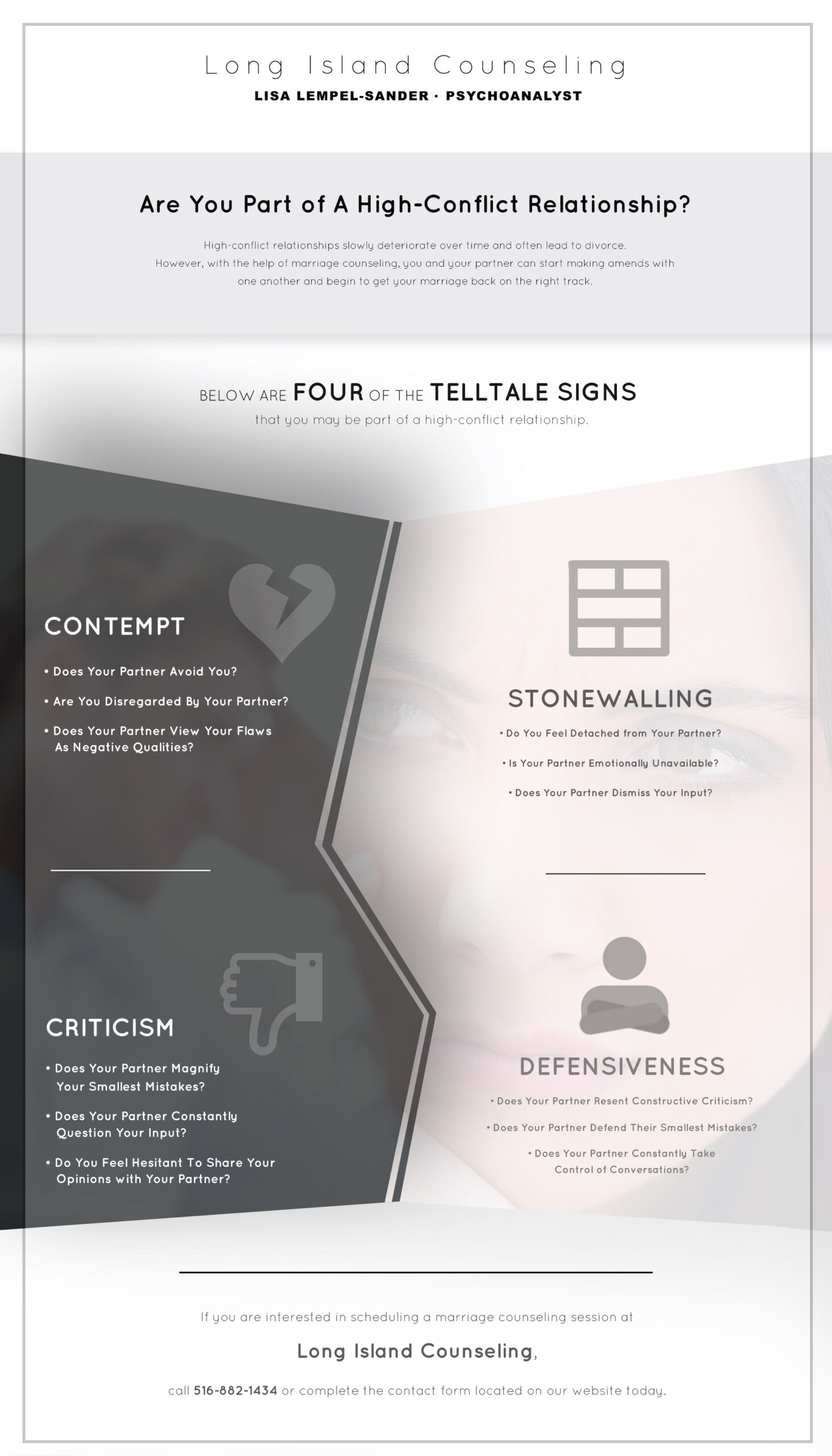
One of the first signs that can indicate that you are part of a high-conflict relationship is experiencing contempt between you and your partner. Contempt can be experienced in many different forms such as being commonly disregarded by your partner, avoidance, and viewing personal flaws as negative qualities. As you can see, contempt can cause extreme tension within relationships.
Stonewalling
If you have experienced your partner being distant from you for extended periods of time, there is a good chance that this could lead to your partner stonewalling you. Stonewalling can be defined as you or your partner putting up a wall between one another which effectively eliminates communication, causes partners to distance themselves emotionally, and ultimately leads to detachment.
Criticism
No one likes criticism, especially if it isn’t warranted or justified. In fact, criticism can often lead partners to tiptoe around one another, which can create a less than desirable environment at home. If you feel that your partner questions everything that you do or say, or focuses on your smallest mistakes, you could benefit from marriage counseling services from Long Island Counseling.
Defensiveness
A defensive partner can make it extremely difficult to maintain an open line of communication in your relationship, which can lead to all of the characteristics developing that were previously mentioned above. If you or your partner are not receptive to constructive criticism, or constantly commandeer conversations between one another, there is a good chance that defensive behaviors are present in your relationship.
These are some of the many signs that indicate that you and your partner could rekindle your relationship by participating in marriage counseling at Long Island Counseling. We work in a safe and confidential environment, so that both you and your partner may feel as comfortable as possible during your visits. If you are interested in scheduling your marriage counseling session, simply call us at 516-882-1434 or complete our contact form located on our website.
Long Island Counseling
Long Island Counseling
Lisa Lempel-Sander LPsyA
Licensed Psychoanalyst
221 Hollywood Ave
Douglaston NY 11363
Contact Us Today!

Couples & Marriage Counseling
Professional marriage counseling and couples therapy helps heal after an affair or infidelity, helps build trust and improve communication, helps resolve arguments about money or sex, and teaches you what each needs to promote intimacy and emotional connection. For all couples looking to strengthen their relationship.

Anxiety & Depression
Therapy provides support and direction in overcoming addiction and substance abuse, in resolving anxiety, depression and other emotional pain including lack of confidence and low self-esteem. Therapy helps with clarifying sexual orientation, gender-based identity questions, LGBT issues, gay and lesbian questions.

Relationship In Crisis
Discernment Counseling has one goal: to help you decide whether to stay in the relationship and try to work it out, or to leave. Discernment Counseling treats both partners even when there’s disagreement about the desired outcome. Discernment Counseling is a brief, highly-focused protocol with just one goal: helping you decide.